CWT: Unlocking Accessible Travel
Credit: Stephanie Lewis, Director, Service Design, CWT with contributions from Richard Thompson, Global Head of ESG and Employee Experience, CWT
CWT arranges corporate travel for businesses of all sizes and travelers with various requirements and preferences. Our accessibility program was designed to provide equal access and barrier-free support for travelers with visible and non-visible disabilities. Led by our Global Solutions Design and Change and Execution teams, the program is a natural addition to our broader portfolio of globally consistent, specialized services.
Collaboration and Listening
We collaborated with prospects, customers, and third-party consultants to fully understand traveler requirements and the current accessibility challenges in business travel. Key themes were identified during the discovery and scoping discussions:
- Individual difference: Support should be tailored to the traveler's unique requirements, not a disability.
- Respecting the traveler’s privacy: The ability to self-disclose needs is vital.
- Needs must be met throughout the booking process and the trip.
- Concerns about suppliers not receiving or acknowledging special assistance requests.
The success of this initiative came from the collaborative efforts of various in-house and third- party contributors:
- The Traveler Experience team, responsible for delivering the service globally
- The Learning and Development team, creating our training materials
- The Product and Technology team, who adapted technologies to support the booking workflow
- The Sales and Customer Management teams, who facilitated various discussions and workshops
Understanding the Bigger Picture
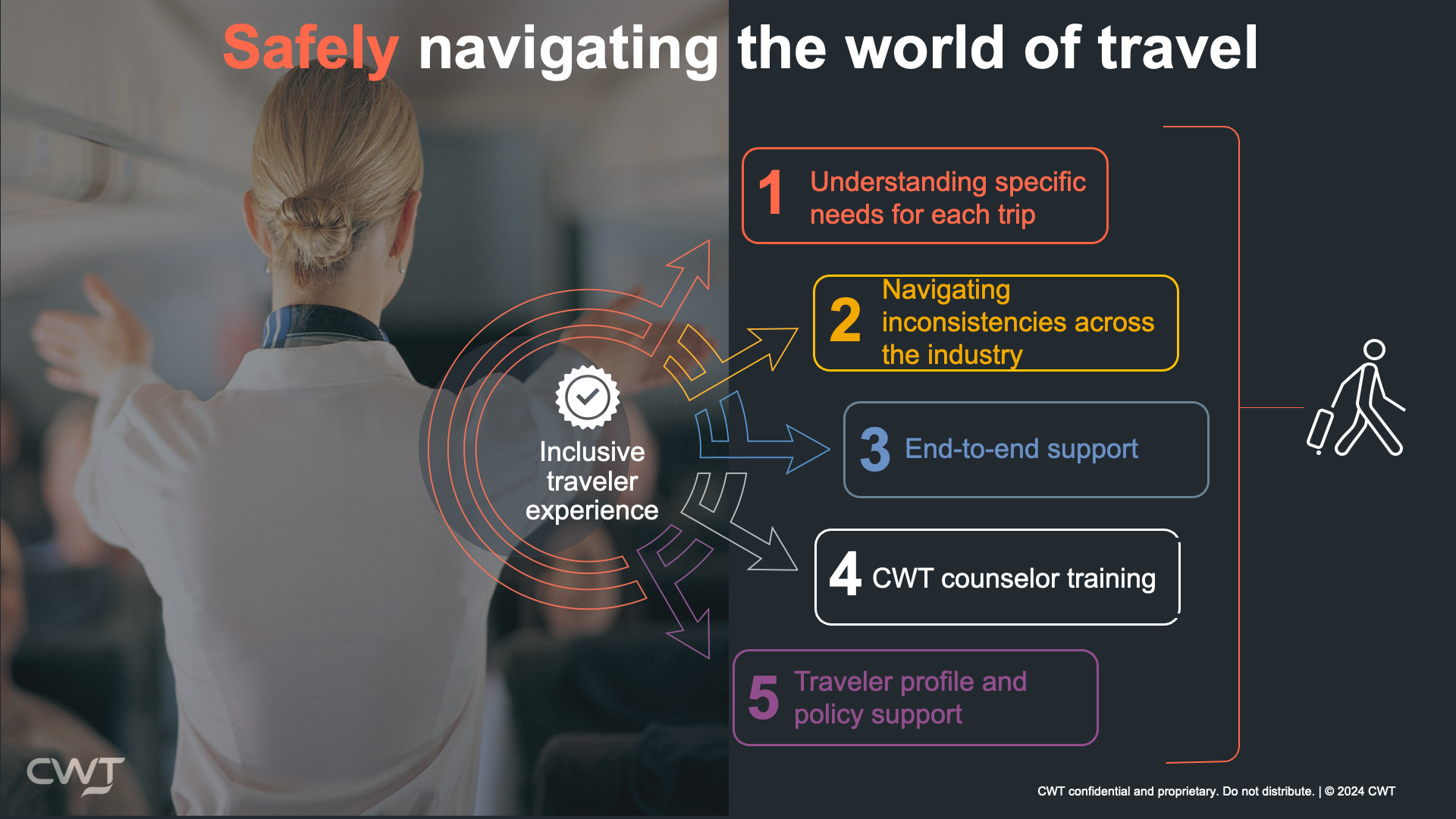 |
As a Travel Management Company (TMC), our role is to source, book, and confirm accessible travel services, but there are other stakeholders with equal impact and accountability in ensuring accessible travel.
Suppliers are ultimately responsible for delivering the services we book, and travelers have a pivotal role in disclosing individual needs and measuring the success of our program through post-trip feedback and insights.
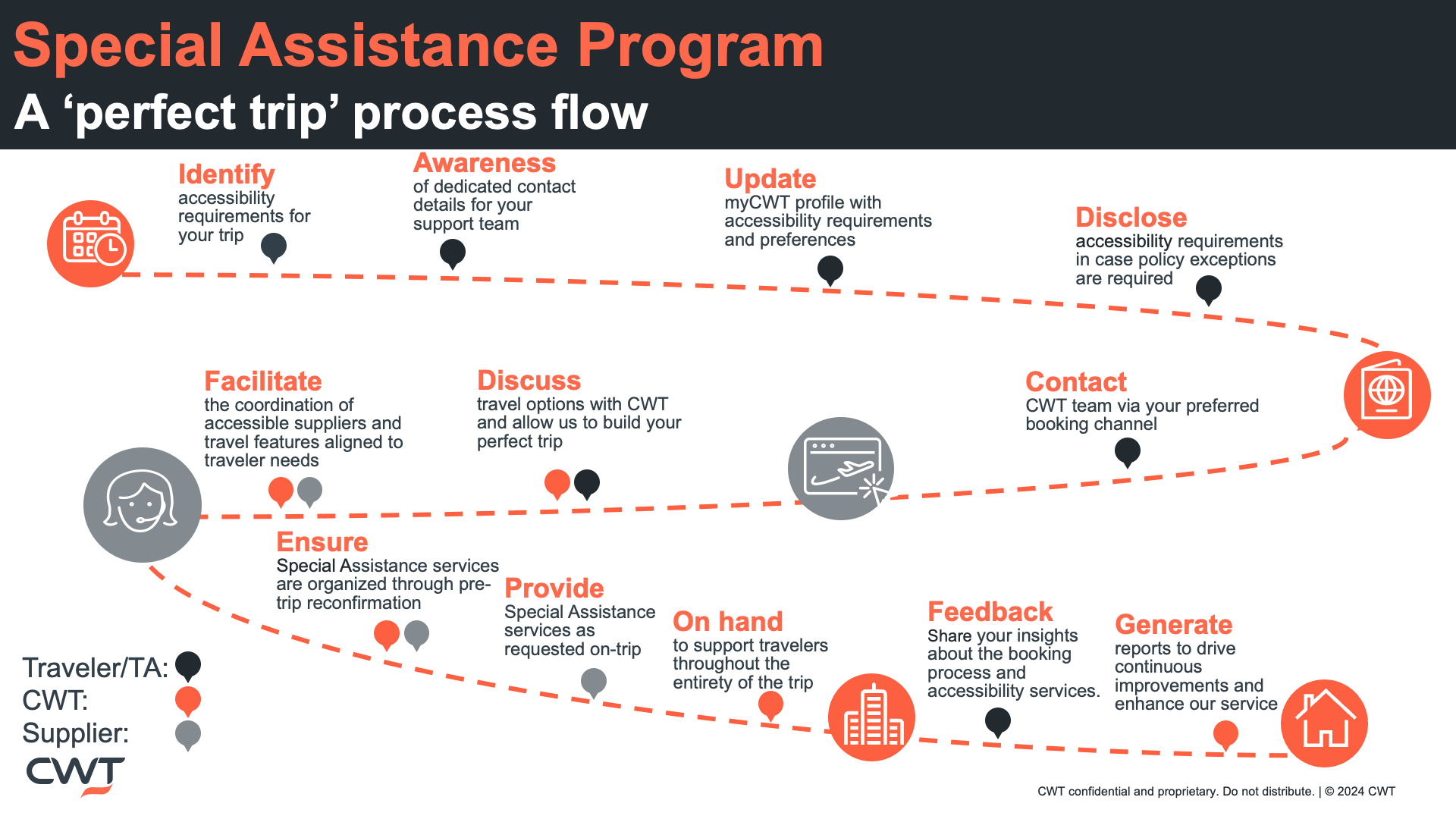
Meticulous planning and door-to-door support are vital components of our offering. In addition to sourcing accessible transport and lodging services, we increased our scope to accessible ground transportation solutions. Plus, the airport became a key player. Understanding accessibility services for departure, arrival, and transient locations is crucial to creating the perfect trip. Every service is reviewed, booked, and verified to ensure needs are accurately recorded. We reconfirm with suppliers 24-48 hours before travel and provide dedicated contact details to special assistance teams if support is needed on-trip.
Training, Communication, Consistency, and Respect
We focused heavily on counselor training, creating a 60-minute interactive training module, delivered in three languages, that includes tactical/process training and enhances communication skills.
We reviewed many online resources, such as The Hidden Disabilities Sunflower, to better understand the challenges travelers experience, and develop our program accordingly. Our aim was to enhance skills such as empathy and awareness, communicating with respect, avoiding ableist language, and building trust to reduce the anxiety experienced by many travelers, while also looking to simplify the booking process for a smoother and more efficient booking experience. We interviewed counselors familiar with booking accessibility services, and encouraged employees with disabilities to share their experiences and provide feedback on the training materials.
While stakeholder engagement and communication were critical in driving internal change, the development of our special assistance program was led by increased customer demand, both for existing customers and for prospects placing more emphasis on inclusivity during the bid phase.
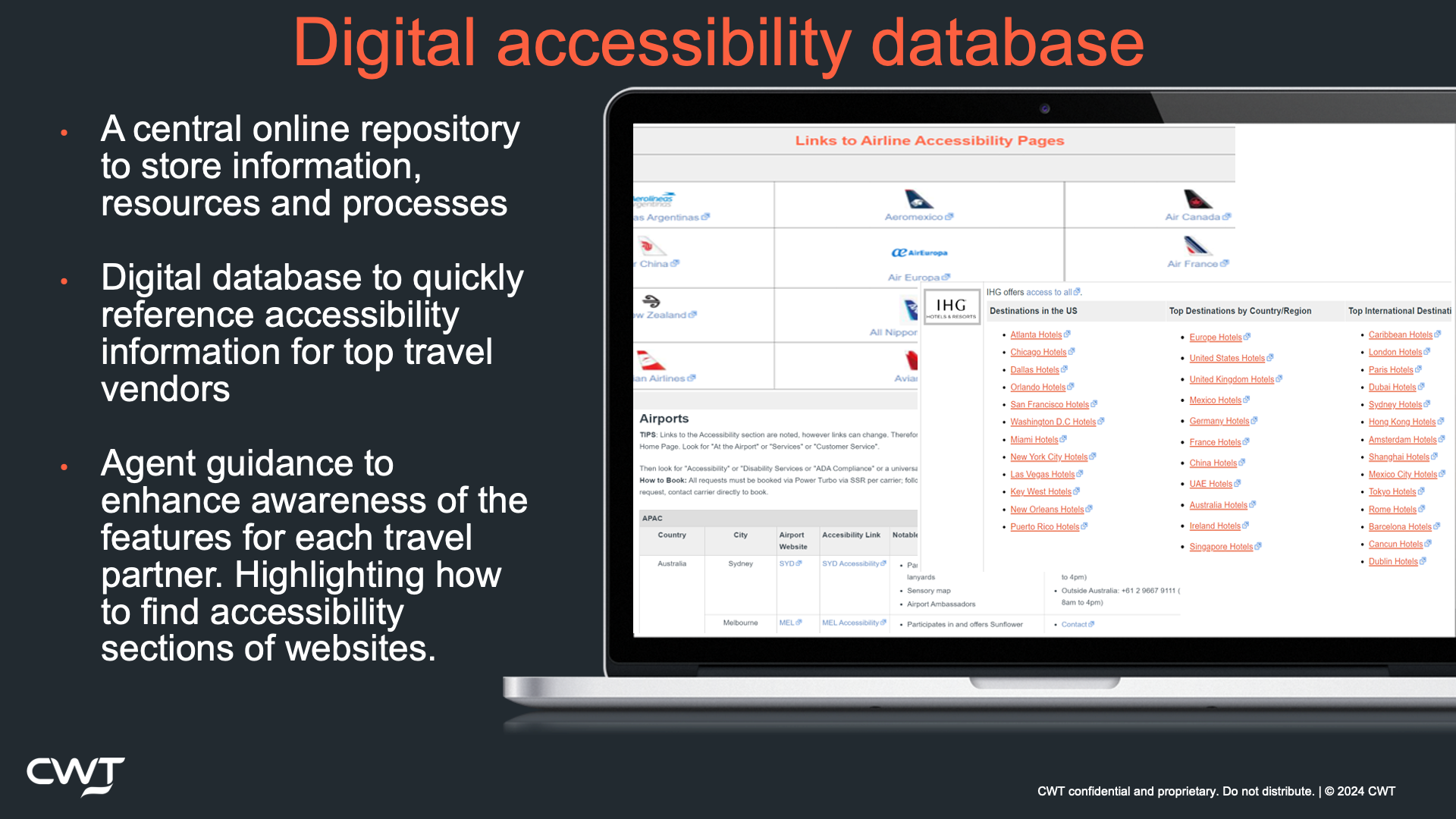 |
While creating the offering, we discovered some recurring issues for travelers with disabilities. First, there is a lack of consistency in accessing and booking services across suppliers, making navigating as a travel booker particularly challenging. Take the example of a wheelchair user. Often there are forms to be completed, which vary between suppliers. They will ask very specific questions around traveler needs. Some suppliers may require a signed physician note, but others don’t.
Language used by suppliers is also inconsistent, making it difficult to find accessibility services and booking processes. For instance, while accessibility services may be available via customer services teams, some use the terminology “special assistance” while others may refer to “support” or “disability assistance”. Even check-in time recommendations aren’t consistent for special assistance, with recommendations of anywhere between 60 minutes and three hours, depending on the supplier.
These inconsistencies make the booking process lengthy and complex, negatively impacting the overall experience for travelers. So, our response was to create a globally accessible digital repository that provides a single access point to accessibility information for our counselor base. This tool has significantly increased our teams' productivity and smoothed the booking process for travelers.
Another hurdle surrounded the reliance on self-disclosure of needs. Needs can be permanent, temporary, situational, and they can change over time. We were keen to provide an unintrusive solution where travelers weren’t forced to disclose their needs during every interaction with us. To do this meant some technology development. We adapted our global profile tool to allow travelers to manage their details directly in their profile, which counselors routinely access. This ensures needs are accounted for during every booking and trip amendment, eliminating the requirement for repeated self-disclosure.
Just the Start
|
We launched the initial version of our program in the first quarter of 2024, and the feedback has been positive. We have collected input from travelers using the special assistance program, plus insights from travel managers involved in its development.
An accurate measure of success is how the user experiences our offering, and we closely monitor traveler feedback to capture insights and improvement opportunities post-trip. We see this as an iterative approach, and the voice of the customer will continue to drive the evolution of our roadmap.
The first version of our special assistance program focused on travelers with disabilities, reflecting the biggest demand we hear from customers and prospects around accessibility today. However, we recognize that accessibility is broader than this, so the model was designed with scale in mind —we will continue to expand it to incorporate additional traveler demographics with emerging customer demands.
Providing accessible travel solutions is a collective industry-wide responsibility, and consistency is crucial in getting this right. Our call to action for industry partners is to embrace collaboration and join forces in our quest to provide equal and barrier-free access to all travelers, driving meaningful industry change, together.
Jump to Top of Page